

- Uncategorized
Effective Fleet Cost Control: How Companies Can Reduce Their Total Fleet Costs
In many organizations, the fleet is one of the largest cost drivers—often without full visibility. Missing data, manual processes, and insufficient reporting lead to decisions being made based on gut feeling rather than accurate metrics.
Yet modern, data‑driven fleet cost control unlocks enormous potential: lower operating costs, improved utilization, and strategic value for management and procurement.
This article outlines the key challenges in fleet management, how to build professional reporting structures, and which measures reduce total cost of ownership (TCO) sustainably.
Why Fleet Cost Control Matters
A fleet is not just a set of vehicles—it’s a strategic financial asset. Without transparency, companies lack insight into:
- Total cost per vehicle
- Utilization and efficiency
- Fuel and charging behavior
- Maintenance and repair costs
- Unplanned costs such as damages or downtime
Only those who understand the full cost structure can make informed decisions about model selection, electrification strategies, and financing methods.
The Most Common Challenges in Fleet Management
Information on costs, fuel transactions, repairs, or leasing is often spread across different systems—or stored manually in spreadsheets.
Without defined metrics, anomalies and cost drivers remain hidden.
Without a TCO approach, businesses see isolated costs but not the true financial impact over the vehicle’s lifecycle.
Data collection, invoice matching, and claims management take unnecessary time and resources.
Rising service costs, fuel spikes, or inefficient usage patterns go unnoticed.
What Good Fleet Reporting Should Deliver to Manage Fleet Cost Control
- Clearly defined KPIs (TCO, cost per km, utilization, efficiency)
- Automated data integration from fuel cards, charging systems, telematics, leasing, etc.
- Regular reports for CFOs, fleet managers, and operational teams
- Dashboards for instant visibility
- Comparison across regions, vehicle segments, or driver groups
Good reporting answers questions such as:
Which vehicles generate disproportionate costs? Which leasing contracts are ending? Which models should be standardized or electrified?
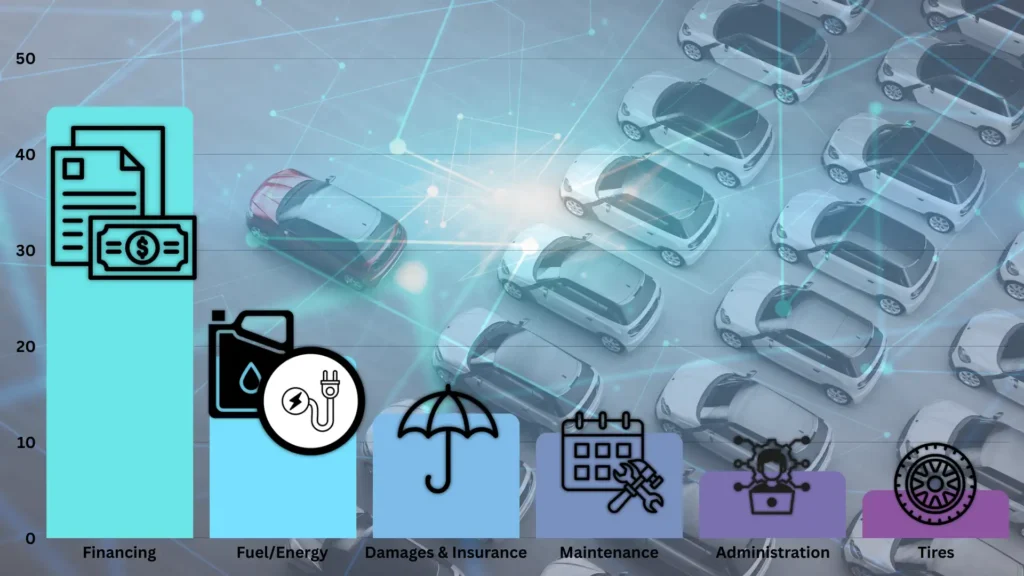
Fleet Cost Structure: Where Money Is Really Spent
A typical benchmark breakdown might look like this:
TCO (Total Cost of Ownership): The Foundation of Accurate Cost Analysis
TCO covers all relevant cost categories throughout a vehicle’s lifecycle.
- Leasing
- Purchase
- Rental
- Depreciation
- Fuel/energy
- Insurance
- Repairs
- Maintenance
- Tires
- Downtime
- Administration
- End-of-contract charges
- Claims handling
How Companies Can Reduce Fleet Costs
- Fuel consumption and transaction analysis
- Identify premium fueling or misuse
- Improve vehicle utilization
- Monitor insurance premiums
- Optimize car policies
- Use multi-bidding for better financing terms
- Select the right financing models
- Reduce end-of-term charges
- Standardize fleet models
- Assess EV/hybrid/ICE usage scenarios
Reducing Fleet Costs Through Digital Tools
Centralized Data
All information consolidated in one platform.
Automated TCO Calculation
No spreadsheets, no manual guessing—just accurate data.
Integration of Key Data Sources
Fuel cards
Charging cards
Telematics
Damage reports
Workshop data
Immediate Detection of Inefficiencies
Inefficient routes
Under- or over-utilization
High energy consumption
Missed service appointments
Improved Planning
Maintenance cycles, contract renewals, replacement strategies, electrification planning.
How Fleetwaro.ai Helps You Even More
With Fleetwaro.ai, the real advantage lies in its powerful AI‑driven processing capabilities. Simply drag and drop your files and documents—Fleetwaro handles the rest automatically. This drastically reduces your workload while minimizing risks and errors to almost zero.
Conclusion: Understanding the Fleet Means Reducing Costs
A transparent, data-driven fleet unlocks substantial savings. Companies that define KPIs, centralize their data, and establish professional reporting can:
 reduce costs significantly operate vehicles more efficiently and sustainably minimize risks improve fleet strategy reduce administrative workload
The journey starts with a simple question: How well do you truly understand your fleet costs today?
Ready to find out with Fleetwaro?

